Qwizcards
Evidence tier: Live bench plus official documentation plus wordpress.org directory metrics.
Identity and official links
- WordPress.org directory: qwiz-online-quizzes-and-flashcards
- Vendor site: qwizcards.net
- Account signup the plugin links to for score recording: qwizcards.net/admin/new_account
- Showcase subsite: wpqp.loca.zone/qwiz
- Live benchmark: wpqp.loca.zone/qwiz/benchmark/
- Core-Six measurement page: wpqp.loca.zone/qwiz/benchmark-core/
- Signature demo: wpqp.loca.zone/qwiz/signature/
- Only admin screen the plugin adds:
Settings → Qwizcards(options-general.php?page=qwiz-admin)
WordPress.org metrics (2026-08-19)
Captured 2026-08-19 from the wordpress.org plugin information API.
| Metric | Value |
|---|---|
| Name | Qwizcards | online quizzes and flashcards |
| Version | 4.02 |
| Active installs | 200 |
| Rating | 100 / 100 |
| Number of ratings | 11 |
| Last updated | 2026-08-06 |
| Tested up to | 7.0.4 |
| Requires PHP | not declared |
| Requires WordPress | not declared |
| Support threads / resolved | 0 / 0 |
The perfect rating rests on eleven ratings against 200 active installs, so it carries almost no statistical weight; the rubric still converts it mechanically. Zero support threads means the directory holds no resolution record at all, which is why the maintenance sub-score for support resolution is 0 rather than a credit for silence. Update recency and tested compatibility are the strongest signals here: the release is thirteen days old and declares the bench’s current WordPress major.
Pricing and source
The WordPress.org package is free and, unusually for this roster, complete: no question type on the coverage record is pro-gated, and no upsell appeared anywhere in the authoring surface. The paid and external boundary sits elsewhere. Recording learner scores and progress reports requires a hosted account — the plugin’s own text is “you will need a Qwizcards administrative account, which you can set up here”, linking https://qwizcards.net/admin/new_account — and its “Enhanced FRQ” AI grading requires a model key: “To use these features you must provide a key for the model API”. Neither was used, so [response], generative_feedback and qrecord_id appear nowhere in the authored markup and nothing in this benchmark leaves the site. The incumbent-claims record keeps the price value null because no qwizcards.net account terms were captured. No paid, nulled, or trial code was installed on the showcase bench. See the licensing and value notes for the showcase rule.
Live coverage summary: Standard Ten (Q1–Q10)
| Question | Type | Status |
|---|---|---|
| Q1 | Single-answer MCQ | ok |
| Q2 | Single-answer MCQ | ok |
| Q3 | Single-answer MCQ | ok |
| Q4 | Single-answer MCQ | ok |
| Q5 | Single-answer MCQ | ok |
| Q6 | Single-answer MCQ | ok |
| Q7 | Multiple-correct | unsupported |
| Q8 | True / false | ok |
| Q9 | Fill-in | ok |
| Q10 | Ordering | unsupported |
Qwizcards has no quiz post type and no quiz builder screen. A quiz is [qwiz] ... [/qwiz] bracket markup and a flashcard deck is [qdeck] ... [/qdeck] markup written inline in ordinary page content, which the plugin’s the_content filter turns into a JavaScript widget at render time. The only native objects created for this benchmark are therefore four WordPress pages: no quiz rows, no question rows, no plugin tables written by hand.
Eight of the Standard Ten are expressible free. Q1–Q6 are native single-answer multiple choice built from [c], [c*] and per-choice [f] feedback; Q8 is the same primitive reduced to two choices, [c*]True / [c]False; Q9 is native free-form input, [textentry suggest="false" use_dict="false" use_terms="false"], which renders input#textentry-qwiz0-q7.qwiz_textentry_no_suggest plus a “Check answer” button and grades case-insensitively — lowercase fe on the benchmark and uppercase FE in the signature page’s inline quiz both returned Correct. Iron's symbol Fe comes from the Latin ferrum., exactly the case-insensitive-exact rule the benchmark quiz specifies.
Two are unsupported, and both were proven by the plugin rather than assumed. Q7 multiple-correct has no select-all-that-apply or checkbox type: multiple choice is single-answer only, and marking two choices [c*] made the plugin’s own page-load checker raise Errors found: followed by More than one choice was marked correct. qwiz: 1, question 1. Q10 ordering has no type at all — the question vocabulary is multiple choice, “Show me the answer”, Enhanced FRQ, hotspot diagram, labeled diagram, free-form input, hangman, hangman-labeled diagram and one-letter answer, and the package’s only sortable code (qwiz_sortable.min.js) is enqueued on admin edit screens for reordering questions, never on the front end. The nearest expressible attempt, marking all four states of water [c*], produced the same alert against question 2.
The plugin’s WYSIWYG “Qwizard” could not be run, and that is an observed limitation rather than an authoring shortcut. The wizard is TinyMCE-only and is reached by starting a Classic block and clicking its [Q] icon; on WordPress 7.0.4 the block-editor canvas is an iframe and core/freeform renders inside it, where window.tinymce is undefined. In the parent document tinymce.editors stayed empty, no .mce-container or .mce-toolbar ever appeared, and the Qwizcards TinyMCE button (Qwizcards - show/restart editing menu) is therefore never created. The plugin’s own readme sanctions the fallback used here — “An interactive what-you-see-is-what-you-get (WYSIWYG) “wizard” makes it easy to create quizzes and flashcard decks, and/or you can edit the shortcodes directly” — so the markup was written directly and then validated by the plugin’s own error checker (Settings → Qwizcards → “Do shortcodes error check every page load”), which reported no error on any of the three quiz pages before being returned to its shipped default.
A logged-out attempt on the benchmark completed: the progress line read 8 Qs, 8 responses, 8 correct, 0 not, 0 to go and the summary report rendered Congratulations, you answered all questions correctly, so completionPass is true.
For the full cross-plugin matrix, see the capability matrix and the comparison index.
Runtime measurements
Captured 2026-08-19 on the Core-Six page, Chromium with cache disabled, logged-out, networkidle2. The optional page-load error checker was switched back off first, so this reflects a default install.
| Metric | Value |
|---|---|
| URL | https://wpqp.loca.zone/qwiz/benchmark-core/ |
| Total requests | 56 |
| JS files / bytes | 42 / 397,368 |
| CSS files / bytes | 8 / 31,483 |
| Total transfer | 506,148 bytes |
| jQuery loaded | no |
| DOM nodes | 741 |
| WordPress / PHP | 7.0.4 / 8.3.33 |
This is the second-heaviest Core-Six page of the fourteen by transfer, behind Academy LMS, and the heaviest by two other measures: 56 requests and 741 DOM nodes are the highest in the field. The cause is structural rather than accidental — the whole quiz is client-side, so the server ships the markup twice (a hidden qwiz_wrapper holding the raw bracket source with base64-obfuscated choices, plus a no-JavaScript fallback button) and 42 JavaScript files build the widget in the browser. jQuery is not among them. See the runtime-weight comparison for the full table and the measurement method.
Signature-feature walkthrough
The signature page proves the plugin’s central claim twice, in one ordinary page’s content:
- Flashcard deck — a
[qdeck]holding the Core Six as term cards. “Start reviewing cards” opens the deck; clicking a card flipsWhat term names molten rock expelled by a volcano?tolava — Lava is molten rock expelled onto Earth's surface; magma remains underground., withFlip back,Need more practice,Got it!andShufflecontrols, and missed cards returning. A seventh card uses the plugin’s hangman input,[q]Chemical symbol for iron [hangman], and rendersChemical symbol for ironplusType letters in the box. - Inline quiz in the same prose — a one-question
[qwiz]further down the page with[textentry]free-form input, which gradedFEasCorrect. Iron's symbol Fe comes from the Latin ferrum.
The benchmark scores quiz mode only. Flashcards, hangman entry and the diagram-labeling types are demonstrated here and deliberately excluded from the Standard Ten record, because the Standard Ten measures scored quiz questions.
Coexistence
Qwizcards activated cleanly on its own subsite and on the coexistence lab and needed no setting change. It is the one roster plugin that contributes no top-level admin menu: its only screen is Settings → Qwizcards, which is why the fourteen-plugin lab shows 13 plugin top-level menus inside 23 total. Activation is not silent, though — it logs PHP Warning: Trying to access array offset on null from qwizcards-plugin.php lines 1946–1986 while probing its own tables, on every site it is activated on; activation still succeeded everywhere. The fourteen-iframe logged-out lab load added zero lines to the debug log, no page error was attributed to Qwizcards, and the lab’s only console error remains the known H5P 403. See the coexistence report for the full capture.
Catches
- Authoring UX is the weakest of the fourteen (4 / 10). There is no builder, no quiz list, no question editor and no post type: quizzes live as bracket markup inside page content, so a typo is a content bug and the only safety net is an opt-in page-load error checker that has to be switched on and off again by hand.
- The WYSIWYG Qwizard, the plugin’s own answer to that problem, does not run on current WordPress. It is TinyMCE-only, and WordPress 7.0.4 renders the Classic block inside the editor-canvas iframe where
window.tinymceis undefined, so the Qwizcards editing menu never appears. - No multiple-correct question type. Attempting one is not merely unsupported, it is rejected by the plugin’s own checker with
More than one choice was marked correct. - No ordering or sequence question type anywhere in the vocabulary.
- Nothing records a score locally. Persisting attempts or reading progress reports requires a qwizcards.net administrative account, and “Enhanced FRQ” grading requires a model API key; without them the quiz is a client-side self-check.
- The package offers no extension surface for other code. The installed 4.02 files contain exactly one
apply_filterscall, and it consumes corethe_content; there is noadd_menu_page, noregister_post_typeand noregister_rest_route. Anything wanting to read Qwizcards results has nothing to read. - Debug noise beyond the activation warnings: nine
PHP Deprecated: Using dollar-brace var in strings is deprecatednotices, plus unconditional diagnostics of the plugin’s own — aninformation_schema.TABLESquery dump and aprint_rof its rows — written once per admin or CLI request, because the plugin never records its text-entry suggestions version as installed and re-verifies every time. - Directory footprint is thin: 200 active installs, eleven ratings, no support-thread record at all.
- Logged-in administrators see
Note: this quiz has not been assigned as work you need to do. Your work will be recorded, but it may not count for your class.on a quiz page, an account-oriented string that reads like a fault on a site with no Qwizcards account.
Audit score
Using the rubric weights, with categories scored 2026-08-19 from live free-tier observation:
| Category | Score |
|---|---|
| Depth | 10 / 10 |
| Author / learner UX | 4 / 10 |
| Logic / results / reporting | 6 / 10 |
| Maintenance / trust | 6.4 / 10 |
| Integrations / data ownership | 4 / 10 |
| Value | 6 / 10 |
| Weighted total | 64.60 / 100 |
Maintenance sub-scores: update recency 10, active installs 2, rating 10, support resolution 0, tested compatibility 10.
Depth 10 / 10 is the highest free-tier depth score in the fourteen-plugin field, and the only 10 awarded in that category: every question type the plugin has is available free, and its type vocabulary is wide. UX 4 / 10 is the lowest of the fourteen. Because the rubric puts 40 percent of the weight on UX plus logic and results, the same plugin lands twelfth of fourteen overall — the clearest illustration in this showcase that free depth and usable depth are different measurements.
Verdict
Qwizcards is the most capability-per-zero-dollars engine on the bench and the least comfortable to author in. If the quizzes are written by someone who is happy in markup, wants flashcards and hangman alongside scored questions, wants free-form text entry graded case-insensitively without paying for it, and does not need results stored, it is genuinely excellent value: eight of the Standard Ten expressed, a completed logged-out attempt, no pro gate anywhere. It is the wrong choice for a team of non-technical authors, for anyone who needs multiple-correct or ordering questions, for anyone who needs local score records or an integration surface, and for pages where 506 KB and 741 DOM nodes for six questions are too much. Its wizard being unreachable on current WordPress makes the markup route mandatory rather than optional, which is exactly the risk to weigh before choosing it.
Visual evidence
Captured 2026-08-19 in desktop Chromium at 960 px content width. Each crop is anchored on the plugin’s own surface and removes browser chrome and unrelated page furniture.
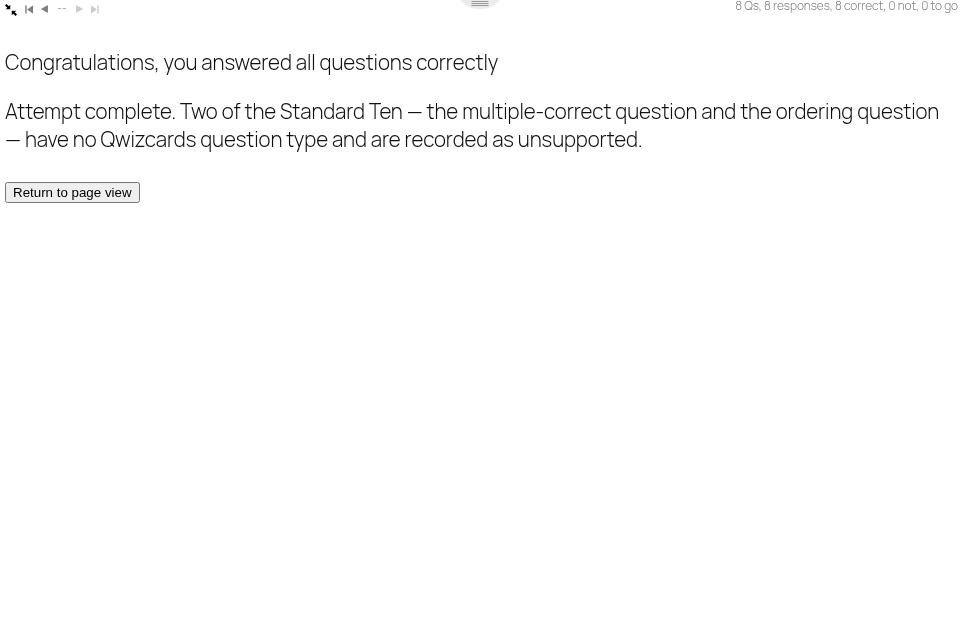
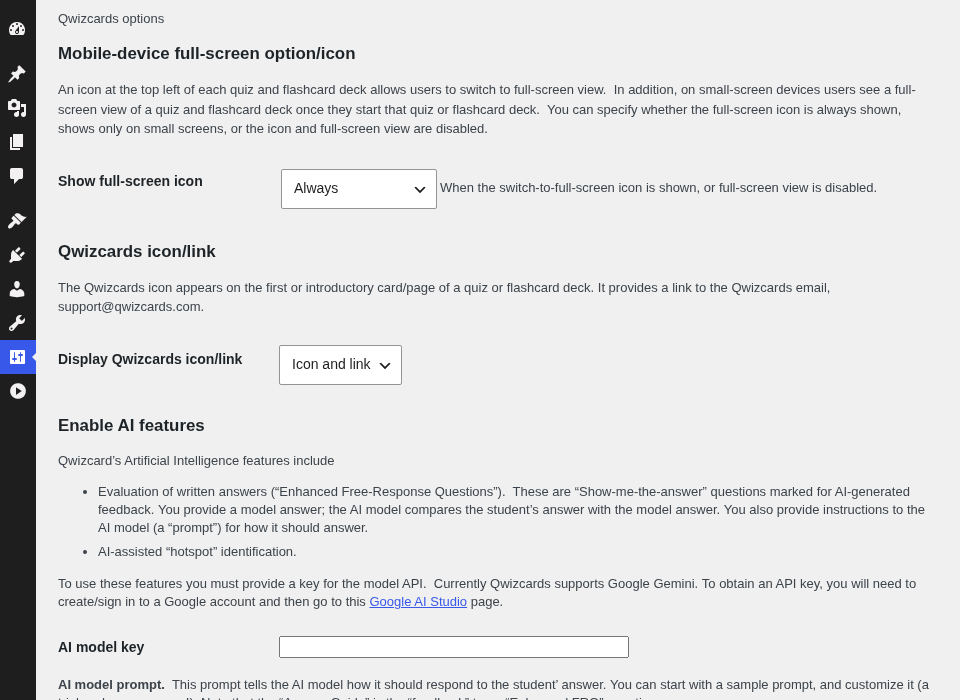
Settings → Qwizcards, which documents the bracket vocabulary instead of offering a quiz builder. Captured from the Qwizcards options screen. Open full-size image.